
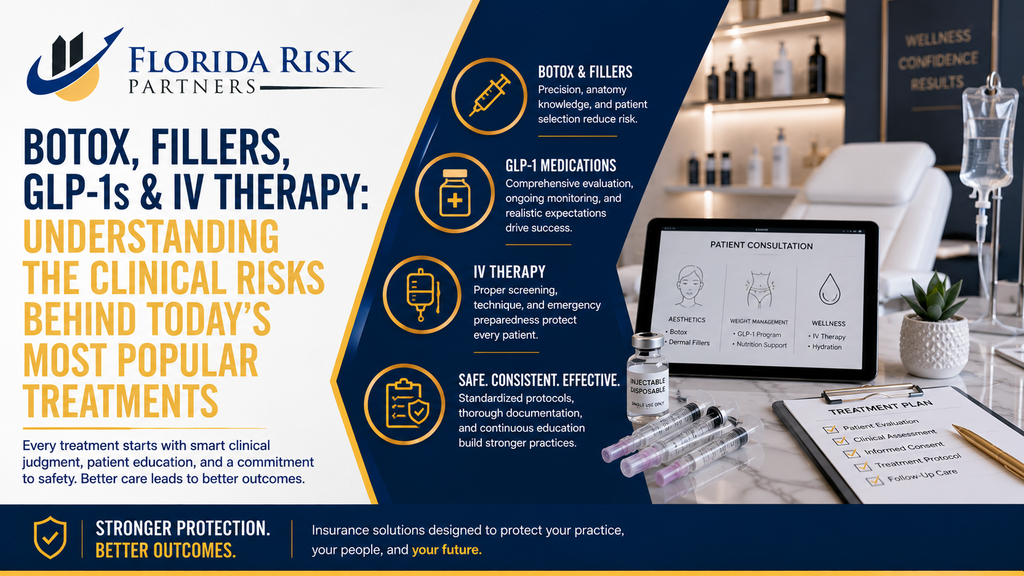
Part 1: Understanding the Clinical Risks Behind Today’s Most Popular Treatments
The modern medical spa industry has evolved at an extraordinary pace. What was once a business centered primarily around cosmetic injectables and skincare treatments has expanded into a broader wellness model.
Today’s medical spas often combine aesthetics, preventive medicine, and lifestyle optimization. Patients now expect more than wrinkle reduction or facial rejuvenation. Many seek medically supervised weight management, vitamin infusions, hydration therapy, wellness programs, hormone optimization, and other services designed to help them look and feel their best.
For medical spa owners, this evolution creates tremendous opportunity. Expanding service offerings can create new revenue streams, strengthen patient relationships, increase treatment frequency, and help practices stand out in a competitive marketplace.
Existing aesthetic patients often become strong candidates for wellness services. Likewise, patients who enter through weight management or IV therapy may later explore cosmetic treatments they had not previously considered.
When practices manage these complementary services effectively, they can improve patient retention and increase the lifetime value of each patient relationship.
Growth, however, always comes with additional responsibility.
Every treatment a medical spa adds changes its clinical risk profile.
Botox injections, dermal fillers, GLP-1 medications, and IV therapy may all exist within the same practice, but they involve very different clinical issues. They also create different documentation requirements, patient education duties, and potential complications.
Successfully offering these services requires more than purchasing products or hiring qualified providers. It requires standardized systems that help every patient receive consistent, thoughtful, and medically appropriate care.
Every Service Comes With Its Own Standard of Care
One of the most important lessons successful medical spa owners learn is that procedures should never function only as revenue generators.
Every service has its own standard of care. Each one also creates responsibilities that extend well beyond the treatment itself.
Understanding those responsibilities helps owners build sustainable programs that protect patients while strengthening the long-term value of the business.
Botox and Neuromodulators Require Careful Patient Evaluation
Botox and other neuromodulators remain among the most commonly requested aesthetic treatments in the country.
Their popularity is understandable. Treatments are relatively quick, patient satisfaction is generally high, and patients can often return to their normal routine with little interruption.
Despite their familiarity, these procedures still require thoughtful clinical judgment and careful execution.
Every injectable treatment should begin with a comprehensive patient evaluation.
Providers need to understand the patient’s medical history, previous cosmetic procedures, allergies, medications, neurological conditions, pregnancy status, and treatment goals before making recommendations.
They should also evaluate facial anatomy carefully because each patient’s musculature, symmetry, and aging process are unique.
Even when providers follow standard dosing guidance, they should individualize the treatment plan. The goal is to create natural-looking results while minimizing unnecessary risk.
Dermal Fillers Create a Different Level of Clinical Risk
Dermal fillers introduce a different category of clinical considerations.
Unlike neuromodulators, fillers restore volume and reshape facial contours by placing product beneath the skin. That process can create a smaller margin for error because providers often work near important vascular structures.
Most treatments occur without serious complications. However, providers still need a strong understanding of facial anatomy and should know how to recognize problems quickly.
One of the most serious filler complications is vascular occlusion. This rare event can occur when filler interferes with blood flow to nearby tissue.
Early recognition and prompt action are critical.
Practices that offer dermal fillers should maintain clear emergency protocols. They should also keep appropriate reversal agents on hand when indicated and provide ongoing education that helps providers recognize early warning signs.
Fortunately, many injectable complications are less severe.
Bruising, swelling, temporary asymmetry, tenderness, minor product migration, and dissatisfaction with cosmetic results account for many follow-up visits.
These situations may not represent medical emergencies, but they still affect the patient experience. If a practice manages them poorly, they can also damage the organization’s reputation or increase professional liability exposure.
Patient Expectations Can Create Liability
Patient expectations play a particularly important role in aesthetic medicine.
Some patients arrive with celebrity photographs or heavily edited social media images. Those images can create unrealistic ideas about what injectable treatments can achieve.
Others expect permanent correction after one visit or believe cosmetic procedures can reverse decades of aging without ongoing maintenance.
Successful providers understand that expectation management matters just as much as injection technique.
Thorough consultations help patients understand realistic outcomes, treatment longevity, possible side effects, and whether they may need additional treatments.
These conversations strengthen informed consent. They also help reduce dissatisfaction by establishing realistic expectations before treatment begins.
GLP-1 Programs Require Ongoing Medical Management
The rapid growth of GLP-1 medications has created another major opportunity for medical spas.
At the same time, these programs introduce a completely different level of clinical responsibility.
GLP-1 receptor agonists first gained widespread use in the treatment of Type 2 diabetes. They have since become increasingly popular for medically supervised weight management.
Their success has encouraged many medical spas to expand beyond traditional aesthetics into longer-term wellness programs.
Unlike cosmetic injectables, GLP-1 programs rarely revolve around one appointment.
Instead, they require an ongoing patient relationship that includes evaluation, medication management, education, and follow-up.
Appropriate patient selection becomes especially important because these medications are not suitable for everyone.
Providers should carefully review medical history, existing health conditions, family history, current medications, previous weight-loss attempts, and treatment goals before deciding whether a patient is a good candidate.
Lifestyle Education Matters in GLP-1 Programs
Providers should also help patients understand that GLP-1 medications are not intended to function as stand-alone solutions.
Sustainable weight management requires nutritional guidance, physical activity, behavioral changes, and regular monitoring in addition to medication therapy.
Patients who expect dramatic results without lifestyle changes may become disappointed.
That makes realistic expectations especially important from the beginning.
Follow-up care also becomes central to a successful program.
Providers should monitor progress, assess side effects, adjust dosing when appropriate, reinforce healthy habits, and communicate regularly throughout treatment.
This ongoing relationship differs significantly from many cosmetic procedures. It requires systems that support long-term patient engagement instead of one-time care.
IV Therapy Requires More Clinical Oversight Than Many Patients Realize
Intravenous hydration and wellness therapy have also grown quickly within the medical spa industry.
Many practices now offer hydration therapy, vitamin infusions, recovery treatments, immune support, and other wellness services.
Patients may view these services as simple, but IV therapy still involves important clinical responsibilities.
Every treatment should begin with a comprehensive patient assessment.
Providers should review medical history, allergies, current medications, cardiovascular conditions, kidney function, pregnancy status, and previous reactions before therapy begins.
They also need to confirm that treatment is appropriate for that patient and clearly explain both the intended benefits and the limitations.
Clinical technique remains important as well.
Proper sterile procedures, careful vascular access, patient observation, and accurate documentation all contribute to safe care.
Practices should also maintain clear protocols for adverse reactions, infiltration, vasovagal responses, allergic reactions, and other unexpected events.
Emergency preparedness does not mean a practice expects complications. It simply shows that the organization is prepared to respond professionally if they occur.
Different Services Still Share the Same Risk Management Principles
Botox, fillers, GLP-1 medications, and IV therapy differ significantly in how providers deliver them.
However, they share several core principles.
Each requires strong patient evaluation, informed consent, accurate documentation, standard protocols, ongoing provider education, and appropriate follow-up.
These elements often influence patient safety as much as the treatment itself because they create consistency across the organization.
Medical spa owners sometimes make the mistake of evaluating services one at a time. They may believe each new treatment simply adds another source of revenue.
In reality, every service contributes to the overall clinical culture of the practice.
Organizations known for disciplined documentation, thorough patient education, standard protocols, and consistent follow-up often build stronger reputations because patients experience the same high standard of care across every service.
Clinical excellence begins long before the first injection, prescription, or IV infusion.
It begins with thoughtful planning, disciplined systems, and a commitment to safe, patient-centered care.
These principles reduce unnecessary risk and help practices build trust that supports long-term patient relationships.
In the next section, we’ll examine how Botox, fillers, GLP-1 medications, and IV therapy change a medical spa’s overall risk profile. We’ll also explain why every new service should trigger a review of insurance coverage, operational procedures, provider responsibilities, and business systems.
Part 2: Expanding Services Means Expanding Your Risk Profile

Successful medical spas continue to evolve.
Patient expectations change. New treatments emerge. Medical advances create new opportunities to improve outcomes and generate additional revenue.
Practices that regularly evaluate new services often position themselves for long-term growth because they remain responsive to changing consumer demand.
Growth, however, should never mean simply adding another procedure to the schedule.
Every new service changes the risk profile of the business.
New Services Change More Than Revenue
When a medical spa expands from Botox and dermal fillers into GLP-1 weight management or IV therapy, the organization does more than create another income stream.
It also changes provider responsibilities, patient expectations, documentation requirements, operational systems, and often the insurance program.
The most successful organizations recognize these changes before they launch new services.
That allows them to build the infrastructure needed to support growth safely and consistently.
Professional Liability Coverage Should Evolve With the Practice
Professional liability insurance should be one of the first areas owners review when introducing new treatments.
Many owners assume that existing professional liability coverage automatically includes every service they add later.
That assumption can create problems.
Insurance carriers generally underwrite coverage based on the operations disclosed during the application process. As the practice evolves, those original assumptions may no longer match the business.
Adding GLP-1 programs, expanding injectable services, introducing IV hydration, or adding hormone optimization may all change the scope of professional services.
Before launching a new treatment program, owners should review their professional liability coverage with an insurance advisor.
The review should confirm that the carrier understands the procedures, medications, and providers involved.
It is far easier to resolve potential coverage questions before treating patients than after a claim occurs.
Provider Changes Require Additional Review
Provider changes deserve the same level of attention.
Growing practices often add physicians, nurse practitioners, physician assistants, registered nurses, or independent contractors.
Each provider creates additional responsibilities beyond scheduling and credentialing.
Medical spa owners should verify that every provider maintains the appropriate license, works within the scope allowed under Florida law, and has proper coverage within the organization’s insurance program.
Medical Director Responsibilities May Change as Services Expand
Medical director relationships should also receive regular review.
Expanding into medication management, IV therapy, or other medical procedures may change the level of physician oversight the practice needs.
Clearly defined responsibilities help reduce confusion.
Practices should document supervision expectations, communication standards, and clinical responsibilities. This creates greater consistency throughout the organization.
Inventory and Medication Controls Become More Important
Operational systems require just as much attention as insurance.
Adding injectables, prescription medications, or IV products creates inventory responsibilities that may not exist in a simpler aesthetic practice.
The organization must store products according to manufacturer instructions. Staff should monitor expiration dates, track inventory, and limit access to authorized personnel.
Temperature-sensitive medications need even more attention.
Improper storage can affect product integrity before anyone realizes a problem exists.
Medication Management Requires Standard Procedures
Medication management extends beyond inventory control.
Practices should establish clear procedures for ordering, receiving, documenting, administering, and disposing of medications.
Consistent processes reduce the chance of human error.
They also demonstrate thoughtful management if regulators, insurers, or attorneys later review an adverse event.
GLP-1 Programs Need Clear Follow-Up Protocols
GLP-1 programs deserve special attention because they involve ongoing prescribing relationships.
Successful programs require regular follow-up, dose monitoring, treatment documentation, and evaluation of side effects.
Providers should also establish clear rules for when to adjust medication, temporarily stop treatment, or refer a patient to a primary care physician or specialist.
These protocols help keep treatment decisions focused on patient needs rather than convenience or scheduling pressure.
IV Therapy Needs Standardized Clinical Procedures
IV therapy creates its own operational challenges.
Although many patients view vitamin infusions as simple wellness treatments, every IV procedure requires sterile technique, monitoring, emergency preparedness, and accurate documentation.
Practices should establish written protocols for patient screening, infusion preparation, treatment observation, post-treatment instructions, and unexpected reactions.
Standardization reduces unnecessary variation and helps maintain a consistent standard of care across providers.
Documentation Becomes More Important as Services Expand
Documentation grows more complex as medical spas diversify their services.
Each new treatment creates additional information that belongs in the medical record.
That may include consultation findings, informed consent discussions, medication lot numbers, dosage information, treatment settings, patient education, follow-up recommendations, and side effect communications.
Thorough documentation serves several purposes.
Clinically, it improves continuity of care.
Operationally, it helps multiple providers work from the same information.
From a risk management perspective, it creates a record of the reasoning behind treatment decisions.
That record may become one of the most valuable resources available if a patient later questions the care they received.
Emergency Preparedness Should Be Specific to Each Service
Emergency preparedness often receives less attention than it deserves.
Every service should have clearly documented procedures for foreseeable complications.
Practices that offer dermal fillers should maintain protocols for vascular occlusion.
Providers who administer IV therapy should know how to respond to allergic reactions, vasovagal episodes, and infiltration.
Organizations that prescribe GLP-1 medications should establish procedures for significant side effects and situations requiring additional medical evaluation.
Preparation does not mean complications are expected.
It means the practice has thought through its response before an emergency occurs.
Training the clinical team on these procedures helps create confidence and consistency during stressful situations.
Growth Affects the Entire Organization
Medical spa owners should also recognize that operational growth extends beyond clinical care.
New services may require changes to scheduling, inventory management, cybersecurity, electronic medical records, patient forms, consent documents, staff training, and quality assurance.
Each change may appear small on its own.
Together, these changes shape the organization’s ability to deliver consistent care as it grows.
One of the biggest mistakes owners make during rapid expansion is assuming that new services can simply fit into existing operations without further planning.
Successful organizations take a different approach.
They review clinical protocols.
They evaluate insurance coverage.
They update documentation.
They complete provider training.
They establish emergency procedures.
They test workflows before scheduling the first patient.
When practices complete these steps in advance, growth becomes much more sustainable.
Expanding services should strengthen a medical spa, not increase its vulnerability.
Botox, dermal fillers, GLP-1 medications, and IV therapy can all improve patient care and support long-term business growth.
They also increase the complexity of the practice.
Owners who understand how each new service affects insurance, operations, documentation, staffing, and risk management can expand with greater confidence.
In the final section, we’ll examine how leading medical spas build sustainable wellness programs through standard clinical systems, continuous education, thoughtful planning, and coordinated risk management.
Part 3: Building Sustainable Wellness Programs That Protect Patients and Your Practice

The most successful medical spas understand that long-term growth rarely comes from offering the largest number of services.
It comes from delivering each service with consistency, professionalism, and a strong commitment to patient safety.
Botox, dermal fillers, GLP-1 weight management, and IV therapy can all create meaningful growth opportunities.
Those opportunities become sustainable only when strong operational systems support them.
Patients Judge the Entire Experience
Patients rarely judge a medical spa based on the outcome of one procedure alone.
They remember the entire experience.
They notice whether the consultation was thorough, whether providers answered their questions, and whether the practice appeared organized.
They also remember how clearly providers explained treatment options, how well the practice set expectations, and how the team responded after treatment.
Together, these experiences shape trust.
That trust often determines whether patients become long-term advocates for the practice.
Consistency Builds Trust
Every patient should receive the same standard of care regardless of the provider or service.
Whether a patient schedules Botox, joins a weight management program, or receives IV hydration, the experience should reflect the same level of professionalism.
The practice should follow clear protocols, document care consistently, communicate effectively, and prioritize patient safety at every stage.
Consistency begins with standard operating procedures.
Successful medical spas avoid relying on individual habits or unwritten processes.
Instead, they develop documented protocols for consultations, medical history reviews, informed consent, treatment planning, documentation, follow-up care, and management of complications.
Standardization offers several benefits.
It reduces variation between providers.
It simplifies onboarding and training.
It creates greater stability as the organization grows.
Most importantly, it helps ensure that every patient receives the same thoughtful approach to care.
Patient Education Should Be an Ongoing Conversation
Patient education is another area where strong practices distinguish themselves.
Many medical spa patients are highly motivated but may have limited knowledge of the treatments they are considering.
Some arrive influenced by social media, celebrity endorsements, or online testimonials.
Others misunderstand GLP-1 medications or expect IV therapy to address concerns beyond its intended purpose.
Successful providers know that patient education is not just a step before signing an informed consent form.
It is an ongoing conversation.
Providers should discuss realistic outcomes, treatment limitations, expected timelines, possible side effects, and follow-up requirements.
These conversations build stronger patient relationships and reduce misunderstandings that can lead to dissatisfaction.
Documentation Supports Better Care
Documentation remains essential as practices grow.
Complete medical records improve continuity of care and show the reasoning behind treatment decisions.
Practices should document consultations, assessments, informed consent discussions, treatment plans, medication administration, follow-up communication, and patient concerns.
As organizations add new services, documentation systems should evolve with them.
Each new procedure should receive the same level of attention as established treatments.
Technology Should Support Good Systems
Technology can improve these processes, but it cannot replace sound clinical judgment.
Electronic medical records, digital consent systems, communication tools, scheduling platforms, and inventory software can all improve efficiency.
However, even advanced technology cannot fix poor clinical decisions or weak procedures.
Technology should strengthen good systems, not substitute for them.
Continuous Education Supports Long-Term Success
Aesthetic medicine changes quickly.
New products, medications, treatment protocols, and technologies continue to enter the market.
Providers who completed their training years ago need ongoing education to stay current.
This responsibility extends beyond physicians and advanced practice providers.
Registered nurses, medical assistants, patient coordinators, and administrative staff all contribute to the patient experience.
Every team member should understand practice protocols, emergency procedures, documentation standards, and communication expectations.
A culture of learning helps everyone contribute to safe and consistent care.
Evaluate New Services Through Both a Clinical and Business Lens
Owners should take a strategic approach when considering new wellness services.
Every new service deserves both a clinical review and a business review.
Patient demand and projected revenue matter, but they should not be the only factors.
Owners should also evaluate provider training, competency, protocols, emergency procedures, documentation systems, staffing capacity, and insurance coverage.
Considering these areas before launch helps reduce disruption and creates a stronger foundation for growth.
Insurance Should Remain Part of Strategic Planning
Insurance should not become an annual administrative task.
As the practice adds services, owners should review professional liability coverage, provider schedules, commercial property values, business income calculations, cyber exposures, and employment practices liability.
The insurance program should reflect the organization as it operates today.
It should not reflect the business from several years ago.
Risk Management Creates Value Beyond Liability Protection
Many owners associate risk management primarily with preventing lawsuits or meeting regulatory requirements.
Those goals matter, but risk management creates broader value.
Strong systems improve efficiency.
Consistent processes improve patient experiences.
Clear procedures increase provider confidence.
Good controls reduce errors.
Disciplined operations can also strengthen the overall value of the business.
Over time, these strengths become competitive advantages.
Patients are more likely to refer friends and family after receiving consistent care.
Providers are more likely to join organizations with strong professional standards.
Insurance carriers may view disciplined organizations more favorably.
Potential buyers may place greater value on businesses with strong documentation, stable systems, and clear governance.
In many ways, the systems behind a medical spa become just as valuable as the treatments it offers.
Ultimately, Botox, dermal fillers, GLP-1 medications, and IV therapy are not simply individual services on a treatment menu.
Together, they represent a broader move toward comprehensive aesthetic and wellness care.
Practices that approach this evolution thoughtfully can grow with greater confidence.
That means investing in provider education, standard procedures, patient communication, documentation, operational discipline, and coordinated insurance planning.
Conclusion
Today’s medical spas have more opportunities than ever to expand services and strengthen patient relationships.
Botox, dermal fillers, GLP-1 weight management programs, and IV therapy allow practices to address a broader range of patient needs.
They also create meaningful opportunities for sustainable business growth.
At the same time, each service introduces additional clinical, operational, and professional responsibilities.
Strong organizations understand that growth is not measured only by the number of treatments offered.
It is measured by the consistency with which the practice delivers those treatments.
Standard protocols, comprehensive patient evaluations, informed consent, ongoing provider education, disciplined documentation, coordinated insurance strategies, and continuous quality improvement all work together.
Together, they help create safer patients, stronger providers, and more resilient businesses.
Florida Risk Partners Insight
At Florida Risk Partners, we believe successful risk management should support growth rather than limit it.
Our role is to help medical spa owners understand how expanding services affect both operations and insurance.
That allows practices to continue innovating with greater confidence.
When patient safety, sound business practices, and comprehensive insurance planning evolve together, medical spas are better prepared to protect their providers, preserve their reputation, and build organizations that can thrive in an increasingly competitive healthcare marketplace.