
Your company wins a commercial repaint. The proposal is approved, the schedule looks workable, and the customer sends its standard contract.
Then comes the insurance exhibit. It asks for additional insured coverage, completed operations, primary and noncontributory wording, a waiver of subrogation, and advance notice of cancellation.
You forward the certificate request to your agent and sign the agreement. A week later, someone discovers that a required endorsement is missing or that the contract demands coverage your insurer will not provide.
Now a paperwork issue can affect the job’s price, start date, and financial risk.
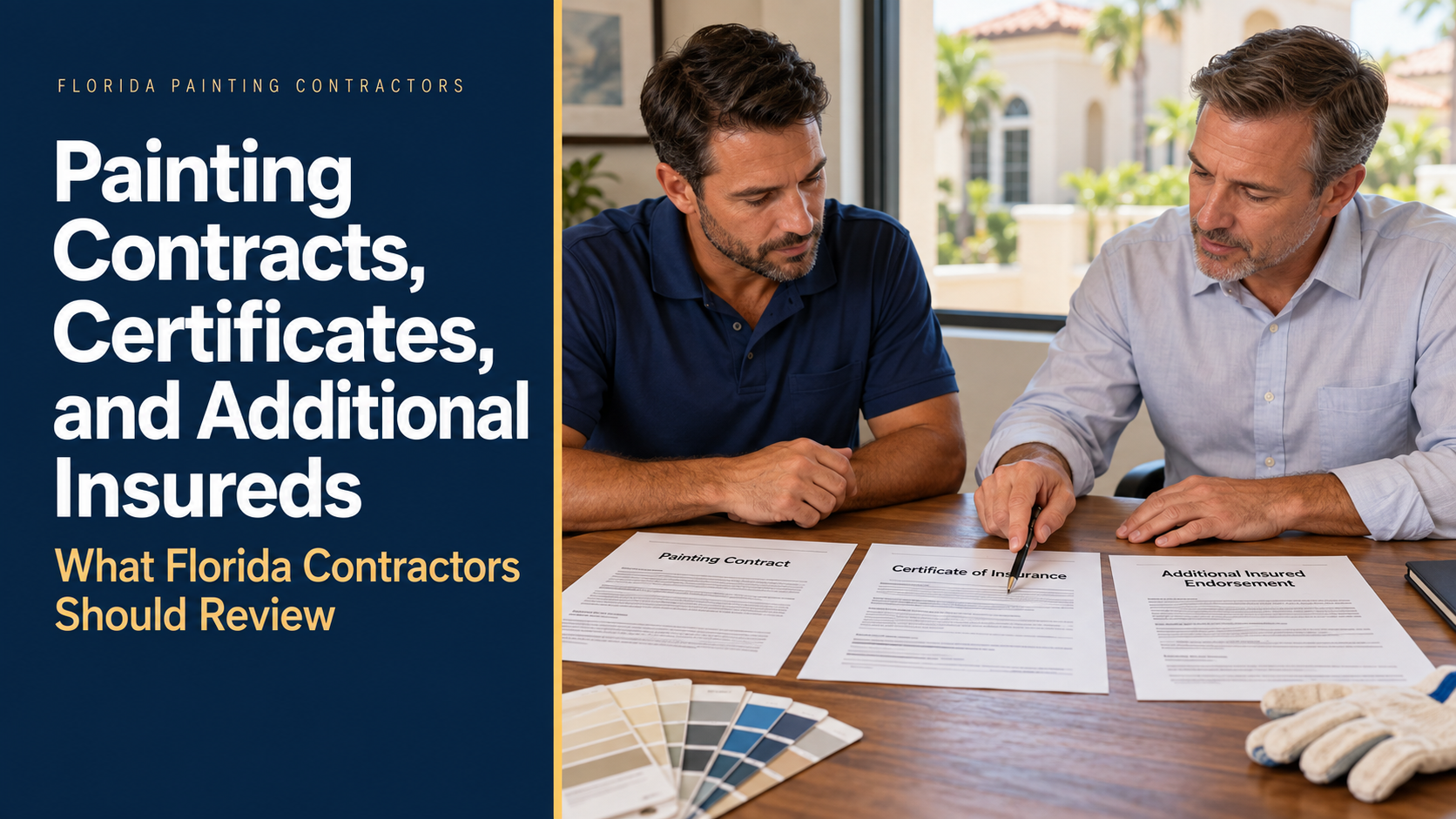
Florida painting contractor contracts deserve an insurance review before you sign. The contract, policy, endorsements, and certificate serve different purposes. Understanding how they fit together helps you make promises your business can support.
This guide explains the terms painters commonly encounter and provides a practical review process for residential, commercial, and association projects.
Examples are hypothetical. Contract enforceability and claim coverage depend on the actual wording, facts, and applicable law. Use your insurance adviser and Florida construction counsel for specific decisions.
Why Florida Painting Contractor Contracts Need an Early Review
The project price tells you what the customer expects to pay. The contract can also tell you which losses the customer expects your company to handle.
Those obligations may appear in the insurance exhibit, indemnity paragraph, warranty, subcontracting section, or general terms.
Consider an occupied condominium repaint. The painting scope may be straightforward, but the agreement could require protection for the association, management company, and another contractor. It might also require coverage after the job ends.
Your estimate should account for those requirements before you commit to the price.
Send the whole agreement
Give your agent the proposed contract, insurance exhibit, referenced attachments, and a description of the work. Send legal provisions that need interpretation to your attorney.
A single page showing liability limits may omit important promises elsewhere. For example, the indemnity section could require defense costs even though the insurance exhibit says nothing about defense.
Ask the customer for any missing documents before signing. If the contract refers to project specifications or a separate vendor manual, obtain them too.
Identify three possible answers
Your review should produce a clear result for each insurance requirement:
- The current policy appears to satisfy it, subject to its terms.
- An available change is needed, with a cost and effective date.
- The requirement needs negotiation because the promised protection is unavailable or unsuitable.
Record the answer and supporting document. This turns the review into a decision your estimator and operations team can use.
The Contract, Policy, and Certificate Serve Different Roles
A signed contract records obligations between the parties. Your insurance policy is the agreement with the insurer. Endorsements modify that policy.
A certificate of insurance, often called a COI, summarizes information such as policy types, limits, and dates. Travelers explains that a COI does not amend coverage or guarantee a claim will be covered. [1]
Use each document for its intended purpose.
| Document | Main purpose | Review question |
|---|---|---|
| Painting contract | Defines the work and promises between parties | What obligations are we accepting? |
| Insurance exhibit | Lists required coverage and terms | Can our policies meet these requirements? |
| Policy and endorsements | Define the insurance provided | Which conditions or exclusions affect the job? |
| Certificate | Summarizes insurance information | Does it accurately reflect the policies? |
| Signed change order | Records an approved change | Does the change require another insurance review? |
The customer may approve your certificate while a contract requirement remains unresolved. Keep a written comparison of the requirements and the actual insurance response.
Start With the Named Parties and Project Scope
Before reviewing form numbers or limits, confirm who is making the agreement.
Check the legal name of your painting business against the policy’s named insured. Also identify the customer, owner, general contractor, management company, and any other party the agreement names.
For an association project, the property manager’s contact name may differ from the association that owns or controls the property. Clarify the correct entity instead of using a familiar building nickname.
Match the scope to insured operations
A proposal for exterior painting can expand into pressure washing, stucco repairs, waterproofing, roof coatings, or sealant work.
List the actual methods, products, work height, and building type. Send those details with the contract so your agent can evaluate the operations your insurer has agreed to cover.
Some contractor policies contain classification, residential, prior-work, or pollution limitations. Others restrict subcontractor-related claims or contractual liability. A broad business description on a certificate may not reveal those forms.
Review performance promises
Pay attention to language promising that a coating will stop leaks, prevent mold, meet a particular slip-resistance result, or last a specified period.
Confirm that the promise matches the product specifications and the work your company can perform. Also distinguish a manufacturer’s warranty from your company’s obligations.
If the customer adds an outcome your estimate did not include, clarify the scope and price. Then ask whether that new obligation changes the insurance discussion.
Certificate Holder Versus Additional Insured
A certificate holder receives proof of insurance. Being listed in that box does not, by itself, make the recipient an insured under your policy. Additional insured protection must come from the applicable policy language or endorsement.
For example, a property manager may ask you to send a certificate to its office. That request is different from a contract requiring the association and manager to receive additional insured coverage.
Ask which parties need which status.
Why customers request additional insured coverage
A customer can be named in a lawsuit involving your operations even when your crew performed the work.
Imagine that a visitor trips over a hose your painters placed across an entrance. The visitor sues both your company and the property owner. The owner wants potential protection under your liability policy for an allegation connected to your work.
Additional insured coverage addresses defined relationships and liabilities. It does not turn your policy into unrestricted insurance for every activity of the customer.
Read the actual endorsement
Ask your agent to identify the endorsement, its edition date, the parties it applies to, and the operations it addresses.
Review the schedule if the form uses one. Confirm names, locations, and project descriptions. If the policy uses automatic or blanket wording, review the contract conditions that activate it.
Save the issued form with the signed agreement. A certificate referencing an endorsement is helpful, but the endorsement itself provides the wording needed for a meaningful review.
Ongoing and Completed Operations: Check Both
An accident during active painting work raises different questions from damage occurring after the work is completed.
Many modern versions of ISO CG 20 10 address additional insured coverage for ongoing operations. CG 20 37 addresses completed operations. Insurers may use equivalent or combined forms, and edition dates can change the scope. Review the actual wording rather than the form number alone. [3]

Ongoing operations example
During an office repaint, your crew leaves equipment in a public walkway. A visitor is injured and alleges that both the painter and building owner failed to keep the area safe.
The additional insured review would consider the endorsement’s relationship to your ongoing work and the particular allegations.
Completed operations example
Months after exterior work, the owner alleges that your preparation damaged an opening and allowed water into the building. The owner receives a claim from an occupant and asks your insurer for protection.
An ongoing-operations endorsement may not address damage occurring after completion. Your agent should review the completed operations requirement before the project begins.
Claim timing deserves careful treatment
The date a complaint arrives does not alone determine whether work was ongoing or completed for coverage purposes. The timing of injury or damage, the work’s status, and policy definitions matter.
Also distinguish a request to maintain completed operations protection for several years from the coverage supplied by one annual policy. Ask how renewals, insurer changes, and cancellation would affect that obligation.
Keep the old policies and project records. A multi-year promise needs a practical plan beyond the initial certificate.
Blanket Additional Insured Coverage Has Conditions
“Blanket” usually means a form can grant status without individually scheduling every qualifying party. It still has conditions.
Some automatic forms require a written agreement with the named insured. Others can address specified upstream parties when the construction agreement requires it. Ongoing and completed operations may require separate treatment.
Suppose you sign a subcontract with a general contractor. The contract also requires the project owner to be an additional insured. Ask whether your automatic wording reaches that owner or only the party that contracted directly with you.
Sign and confirm before mobilizing
A blanket endorsement may contain timing requirements for the written agreement. Review those requirements before starting work or accepting a late request.
Do not assume that a certificate issued after an accident fixes a missing agreement or endorsement. Preserve the timeline and report the event through the policy’s claim process.
Identify every requested party
Avoid a vague list such as “owner and all related entities” without understanding whom it includes.
Ask the customer for names and relationships. Send the list to your agent and counsel. They can determine whether the requested protection fits the available wording and whether the contract needs revision.
What Does Primary and Noncontributory Mean?
This phrase addresses how insurance may respond when more than one policy could protect an additional insured.
In general, primary wording calls for the specified policy to respond before certain other insurance. Noncontributory wording calls for that policy not to seek contribution from the additional insured’s other insurance in the circumstances described. The actual other-insurance provisions and endorsements control.
It does not increase the limits or remove unrelated exclusions.
Ask which policies the requirement applies to
A contract may request primary and noncontributory protection on GL, auto, or umbrella coverage. Do not assume a GL endorsement changes every policy in your program.
List each requested line separately. Ask your agent whether the policy already contains the needed wording or whether an endorsement is available.
Then record any cost, conditions, and effective date before agreeing to the requirement.
Waiver of Subrogation: Understand the Recovery Rights
Subrogation is an insurer’s ability, after paying a covered loss, to pursue recovery from a responsible party. A waiver can restrict that recovery against a specified party under stated conditions.
The request can appear in GL, workers’ compensation, auto, or property requirements. Each line needs its own review.
A waiver is different from additional insured status
A waiver addresses recovery rights. Additional insured wording addresses who receives defined liability protection.
A customer may request both. Confirm what the contract requires and what each policy provides.
Check specific and blanket wording
Workers’ compensation waivers may be written for a specified party or on a blanket basis tied to qualifying written agreements. Travelers describes both approaches.
Ask whether the waiver applies to the correct entity and job. Also check whether your contract promises a broader waiver than the endorsement grants.
Resolve that question before signing. An office employee should not edit a certificate to suggest a waiver the policy does not provide.
Indemnity, Hold Harmless, and Defense Obligations
An indemnity provision can require one party to reimburse or protect another against specified losses. A defense obligation concerns handling or paying for legal defense. These promises can be related, but their wording and effect differ.
Read the triggers. Does the provision address your negligence, your subcontractor’s work, any claim connected to the project, or another party’s conduct?
Send broad or unfamiliar wording to counsel. Also ask your agent how the insurance addresses the liability being assumed.
Florida limits some construction indemnity provisions
Florida Statute 725.06 restricts specified construction indemnity arrangements. For provisions involving liability caused wholly or partly by the party receiving indemnity, it includes conditions such as a commercially related monetary limitation, along with other restrictions. The statute also treats public-agency construction contracts separately.
Whether a particular painting agreement falls within the statute, and how the provision should be written, requires legal review. Do not assume every broad clause is enforceable or that every broad clause is automatically void.
Insurance and enforceability are separate questions
Even a legally enforceable obligation may extend beyond your insurance. Conversely, a coverage issue does not by itself decide whether the customer can enforce a contract promise.
Use two reviews: counsel evaluates the legal obligation, and your agent evaluates the available insurance. Bring the answers together before committing.
If a requirement cannot be supported, negotiate a written revision. Save the final signed version so the office and crew work from the same agreement.
Contractual Liability Does Not Mean Every Contract Loss Is Covered
The phrase “contractual liability” can sound broader than the coverage actually provided.
A CGL policy may address certain assumed liabilities within its definitions and exceptions. Endorsements can narrow that protection. Your agent should review the indemnity promise against the particular contractual liability wording.
Do not treat GL as a budget for every warranty dispute, missed deadline, payment disagreement, or cost of correcting your work.
Review business terms alongside insurance terms
Look for attorney-fee provisions, delay penalties, retainage, warranty obligations, and payment conditions. These can affect profitability even when they do not involve an insured accident.
For an occupied property, clarify access delays and customer responsibilities. If residents do not move vehicles or provide promised access, the contract should explain how the schedule and price are handled.
A clear scope and change procedure can reduce disputes that insurance was never intended to resolve.
Limits, Aggregates, and Deductibles Need a Comparison
A customer may request an each-occurrence limit, a general aggregate, a products-completed operations aggregate, or a per-project aggregate endorsement.
Ask your agent to compare every request with the policy. Do not assume that a per-project general aggregate also creates a separate completed operations aggregate for each job.
For example, a contract might request $1 million each occurrence and $2 million aggregate. Those are illustrative amounts, not a universal Florida minimum or a recommendation for every painter.
Confirm umbrella and excess requirements
If the agreement permits an umbrella or excess policy to help meet the limits, review how that policy applies above the underlying coverage.
Ask whether it recognizes the intended additional insureds and whether exclusions affect the project. An extra limit does not necessarily solve a coverage gap in the underlying form.
Review your share of a claim
Identify deductibles, self-insured retentions, and any special terms for subcontracted work. Confirm whether defense expenses reduce limits or create an additional obligation for your business.
The contract may also restrict the deductible or retention you can carry. Check that requirement before presenting the certificate.
Cancellation Notice: Check What Is Actually Promised
A contract can require your company to tell the customer about cancellation, nonrenewal, or material changes. It may instead demand direct notice from the insurer.
Those are different responsibilities. Ask who must send the notice, which events trigger it, and what advance period is required.
Travelers describes third-party notice endorsements as one way a workers’ compensation carrier may undertake specified notification duties. Availability and wording must be reviewed for the policy involved.
Do not rely on the certificate holder box
Being a certificate holder does not, by itself, guarantee every cancellation notice the customer wants. Review the policy and any notice endorsement.
If the insurer offers different notice terms, explain the difference and negotiate it before signing. Also establish an office procedure for notices your company must send directly.
Calendar renewal dates for contracts that require continuous coverage. A lapsed policy can create a contract issue even when no claim has occurred.
How to Request an Accurate Certificate
Send a complete request to your agent after the requirements have been reviewed.
Include the customer’s correct legal name and address, project location, contract insurance exhibit, requested parties, and start date. Identify any endorsements that need to accompany the certificate.
Then compare the issued documents with the request. Check names, dates, policy lines, limits, and project information.
Avoid certificate shortcuts
Do not alter an issued certificate or ask for a statement that goes beyond the policy. If a portal rejects the documents, obtain the stated reason and send it to the agent.
Some customer portals use rigid wording or outdated form requirements. Resolve those discrepancies with the customer and insurer rather than treating portal acceptance as proof of coverage.
Keep the final certificate and issued endorsements together. Also save the written approval of any negotiated requirement.
Bring Subcontractor Requirements Into the Same Process
If you subcontract part of the job, review how your promises to the owner connect to the subcontractor’s insurance.
For example, the owner may require additional insured protection connected to work performed by your sub. Your own policy may also impose conditions on subcontractor agreements and insurance records.
Use the pre-start process from Article; Hiring Painting Subcontractors in Florida: Insurance Checks Before Work Begins. Confirm workers’ compensation evidence, the sub’s scope, GL endorsements, and the signed agreement.
Make responsibility clear
Decide who protects customer property, coordinates occupancy, handles waste, and reports incidents. Put those responsibilities in the subcontract and discuss them at the kickoff meeting.
If the customer adds a new operation, review whether the sub remains qualified and insured for it. Approval for an interior repaint should not silently become approval for roof coatings or lead-related removal.
A Seven-Step Contract Review for Florida Painters

Use this process before promising a start date.
1. Gather the full agreement
Collect the proposal, owner contract, insurance exhibit, specifications, and referenced attachments. Confirm which document controls if provisions conflict.
2. Describe the actual operation
Record surfaces, methods, products, height, property use, occupants, and subcontractors. Include any performance promise that goes beyond ordinary painting.
3. Build a requirements list
List coverage lines, limits, additional insured parties, ongoing and completed operations, waivers, notice obligations, and required duration.
4. Send it for insurance review
Ask the agent to identify what is already provided, what requires an endorsement, and what needs negotiation. Obtain costs and effective dates.
5. Obtain legal review where needed
Have counsel evaluate indemnity, defense, warranties, delay terms, and unusual obligations. Ask for wording appropriate to the project and Florida law.
6. Finalize before mobilizing
Sign the agreed version, obtain issued documents, and resolve portal or customer objections. Give operations the approved scope and conditions.
7. Monitor through completion and renewal
Review change orders and policy renewals. Retain the records needed for future allegations and ongoing contractual obligations.
Assign one person to approve the file. A clear release decision prevents an estimator’s verbal promise from bypassing the review.
Contract Red Flags Worth Investigating
Pause for review when a requirement:
- Calls for coverage your insurer does not offer.
- Names unidentified affiliates or parties with unclear roles.
- Demands an old endorsement without allowing a suitable equivalent.
- Requests ongoing and completed operations but only supplies one form.
- Requires unlimited indemnity or defense for broad categories of conduct.
- Requires notice terms the policy does not provide.
- Promises a coating result outside the written scope or product specifications.
- Requires insurance for several years without a renewal plan.
- Expands your work into an operation your agent has not reviewed.
A pause can lead to a revision, endorsement, or clarified scope. Record the resolution so the same issue does not reappear at invoicing or renewal.
Keep a Contract File That Supports a Future Claim
Retain the signed agreement, insurance exhibit, certificates, endorsements, change orders, approvals, product records, and completion photographs.
Travelers recommends accessible project records and a retention policy reviewed with counsel. Electronic records should remain usable as systems change.
Save superseded drafts separately from the final agreement. Mark the version operations should use.
If an incident occurs, report it as required by the policy. Forward demands and legal papers promptly. Coordinate any request for an additional insured defense with the insurer, and preserve the documents showing the relationship and timeline.
Review the Promises Before You Sign
Florida painting contractor contracts can shape your risk long after the customer approves the color or pays the invoice.
Make the review part of estimating. Compare the scope and contract with the policy, obtain the needed endorsements, and document requirements that must be negotiated.
Then keep the file current through changes, completion, and renewal.
Before your next signature, send the entire agreement and work description to your insurance adviser. Have Florida construction counsel review provisions that need legal interpretation. A clear answer before work begins is easier to act on than an unresolved promise after a loss.
Frequently Asked Questions
No. Compare the contract with the policy and endorsements. Acceptance may resolve a customer’s administrative step while a substantive requirement remains unanswered.
It depends on the forms. Ongoing and completed operations can require separate endorsements, while some insurer forms combine protection. Review the edition and wording.
No. The form defines qualifying parties and contract conditions. Ask whether it addresses both your direct customer and any requested upstream parties.
Ask the agent to review the request and timing. Do not assume a later certificate or endorsement changes coverage for an earlier event.
No. One is a contract promise; the other concerns defined protection under a policy. Review both, including how defense and insurance obligations interact.
Your agent can review insurance requirements and available coverage. Use counsel to evaluate enforceability and draft or revise legal obligations.