Part 1: Understanding the Five Pillars of Medical Spa Risk
Running a successful medical spa requires more than delivering exceptional aesthetic treatments.
Owners make decisions every day that affect patient safety, employee wellbeing, financial stability, regulatory compliance, technology security, and business value.
Each responsibility creates a different set of risks.
Many of those risks extend well beyond what most people think about when they hear the word insurance.
The right policies matter.
However, successful medical spa owners understand that insurance forms only one part of a broader risk management strategy.
The real objective is not simply transferring risk to an insurance company.
It is building a resilient business that can withstand unexpected challenges and continue serving patients profitably.
Insurance Policies Should Work Together
One of the most common mistakes business owners make is treating insurance policies as unrelated purchases.
Professional Liability protects one area of the business.
Workers’ Compensation addresses another.
Cyber Liability protects against digital risks.
Property Insurance protects physical assets.
Viewed separately, each policy solves a different problem.
In practice, the exposures overlap.
A patient injury may create professional liability concerns and regulatory issues at the same time.
A cyberattack can interrupt operations, trigger privacy obligations, and create financial losses.
A hurricane can damage property, disable equipment, interrupt cash flow, and prevent employees from working.
The strongest insurance programs recognize these connections.
They address risk through a coordinated strategy rather than isolated policy purchases.
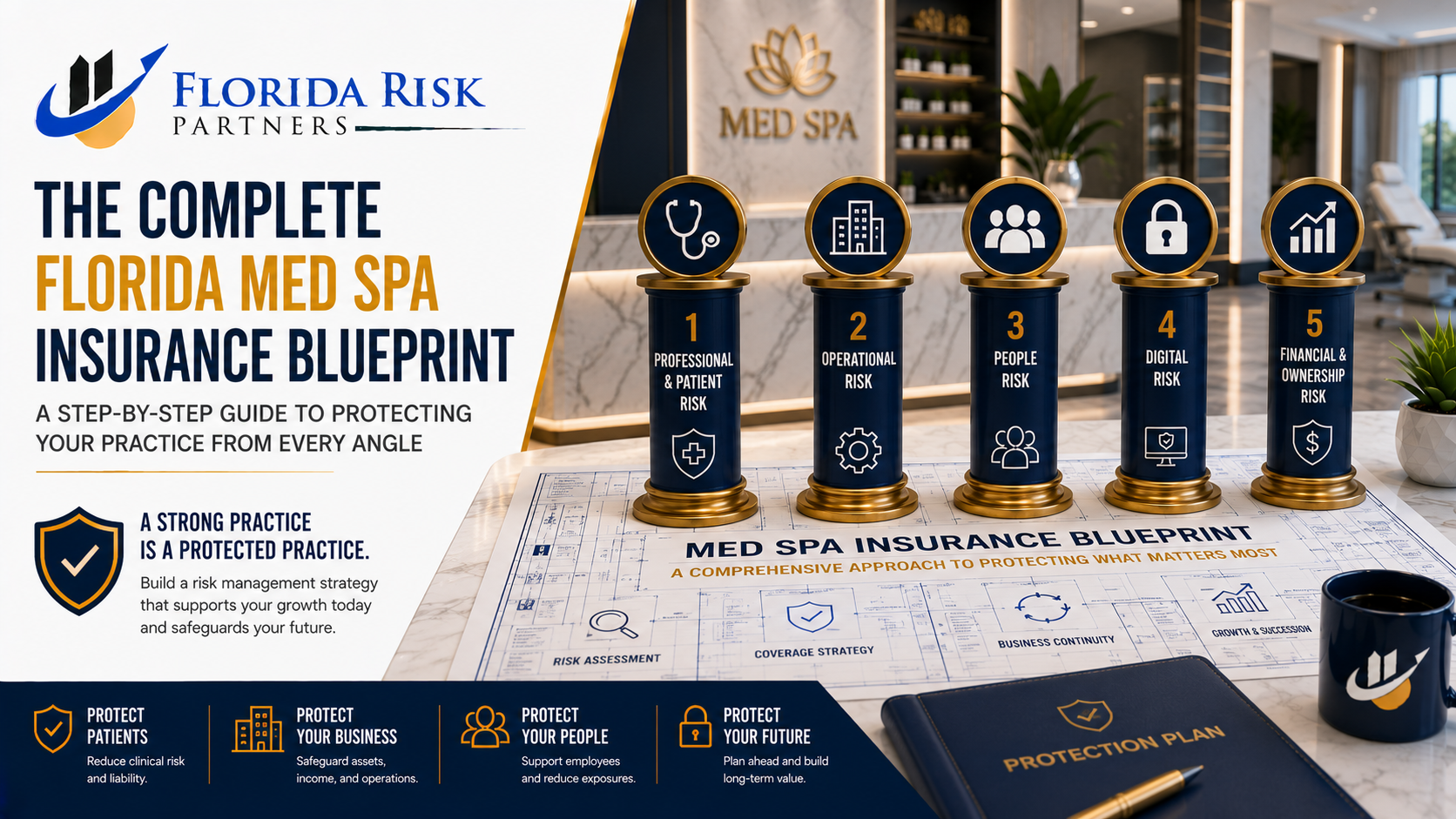
A Five-Pillar Framework Makes Risk Easier to Understand
Medical spa owners can simplify risk planning by organizing exposures into five primary categories.
Those pillars are:
Professional and Patient Risk.
Operational Risk.
People Risk.
Digital Risk.
Financial and Ownership Risk.
Every medical spa has unique characteristics.
Still, most major exposures fit into one of these five areas.
This framework helps owners identify vulnerabilities more systematically.
It also reduces the chance that a major exposure gets overlooked during insurance planning.
Pillar One: Professional and Patient Risk
Professional and Patient Risk sits at the center of every medical spa.
Patients expect providers to perform procedures safely.
They also expect honest communication, informed consent, accurate documentation, and appropriate care.
Every consultation, treatment, and patient interaction carries risk.
Possible allegations may involve treatment complications, burns, scarring, infections, or medication errors.
Claims can also arise from poor cosmetic outcomes or missed contraindications.
Most treatments occur without serious problems.
Even highly skilled providers, however, can face allegations despite following appropriate protocols.
Professional Liability Supports Clinical Risk Management
Professional Liability Insurance helps protect providers and businesses against allegations arising from professional services.
Insurance alone cannot prevent claims.
Strong clinical systems remain essential.
Good documentation helps.
So do informed consent, standardized treatment protocols, provider education, and appropriate physician oversight.
Equipment training and clear patient communication also reduce exposure.
Professional Liability Insurance should therefore support a larger commitment to patient safety.
It should not replace that commitment.
Pillar Two: Operational Risk
Operational Risk focuses on the systems and assets that keep the practice functioning.
Every medical spa depends on facilities, treatment rooms, equipment, technology, utilities, inventory, and vendors.
Patients may never notice these systems when they work properly.
They notice immediately when they fail.
Commercial Property Insurance can protect physical assets.
General Liability can address premises-related exposures.
Equipment Breakdown can help with certain internal mechanical and electrical failures.
Business Income coverage can protect revenue during qualifying interruptions.
Crime coverage, Commercial Auto, and Umbrella Liability may also play a role depending on the operation.
Operational Risk Extends Beyond Insurance
Owners should not think about Operational Risk only after something breaks.
Preventive maintenance matters.
Vendor relationships matter too.
Lease agreements, inventory controls, and disaster planning also deserve attention.
Florida medical spas face hurricanes, severe thunderstorms, flooding, power outages, and equipment failures.
Any of those events can interrupt operations.
Planning ahead allows the practice to respond with more control.
Insurance works best when operational procedures support it.
Pillar Three: People Risk
Employees represent one of a medical spa’s greatest assets.
They also create a major area of exposure.
A successful practice may rely on physicians, nurse practitioners, physician assistants, nurses, aestheticians, patient coordinators, and administrative staff.
Hiring skilled people creates responsibilities.
Employee injuries can occur.
So can disputes involving hiring, compensation, performance management, harassment, discrimination, or termination.
Leadership quality directly affects these risks.
Workers’ Compensation and EPLI Address Different Problems
Workers’ Compensation Insurance addresses job-related injuries and illnesses.
It may provide medical benefits, wage replacement, and rehabilitation benefits according to the policy and applicable law.
Employment Practices Liability Insurance addresses different allegations.
Those may include wrongful termination, discrimination, retaliation, and harassment.
Both coverages matter.
Neither should serve as the first line of defense.
Strong hiring practices reduce risk.
Clear employee handbooks help.
Leadership training, performance documentation, safety programs, and open communication also strengthen the organization.
Pillar Four: Digital Risk
Digital Risk continues to grow as medical spas depend more heavily on technology.
Modern practices use electronic records, online scheduling, payment systems, digital imaging, cloud storage, and patient portals.
Many also rely on connected treatment devices.
Technology improves efficiency.
It also creates new responsibilities.
Sensitive patient information must remain protected from cybercriminals, system failures, and human error.
Cyber Liability Addresses More Than Computer Repairs
Cyber Liability Insurance can address financial losses arising from covered cyber events.
A data breach may create forensic expenses.
It can trigger legal costs, patient notification obligations, and credit monitoring expenses.
Ransomware may interrupt operations.
Public relations expenses can arise after a breach.
Business interruption losses may also become significant.
Protecting digital assets requires more than antivirus software.
Multi-factor authentication, employee training, secure backups, and software updates all matter.
Access controls, vendor oversight, and incident response planning strengthen the organization’s cyber resilience.
Pillar Five: Financial and Ownership Risk
Financial and Ownership Risk often receives less attention than it deserves.
Every owner eventually faces important business decisions.
The practice may expand.
It may borrow money, acquire another business, add partners, or plan for succession.
Retirement and an eventual sale can also become major priorities.
These events create risks that extend beyond patient care.
Business continuity, disaster recovery, contractual risk transfer, valuation protection, and ownership planning all affect long-term business value.
Protecting Cash Flow Is Part of Ownership Risk
Financial risk also includes protecting the cash flow that keeps the practice operating.
A property loss may interrupt revenue.
Equipment failure can do the same.
Cyber incidents and severe weather can create similar problems.
Business Income and Extra Expense coverage can become especially important during these disruptions.
Buyers and sellers also benefit from insurance reviews before ownership transitions.
Historical claims deserve attention.
So do employment practices, equipment maintenance, operational risk, and regulatory compliance.
Protecting business value means preparing for future events.
It requires more than solving today’s operational issues.
The Five Pillars Overlap
No single policy can protect a modern medical spa from every risk.
The pillars connect to one another.
Patient safety affects regulatory compliance.
Employee training can influence professional liability.
Cybersecurity affects business continuity.
Property protection supports financial stability.
Ownership planning protects long-term value.
A five-pillar framework helps owners move away from reactive insurance buying.
It encourages a coordinated risk management strategy instead.
Part 2: Building an Insurance Program That Works Together Instead of Standing Alone

Medical spa owners gain significant value when they stop viewing insurance as a collection of separate policies.
Many businesses purchase coverage at different times for different reasons.
Professional Liability gets renewed because it is necessary.
Workers’ Compensation remains in place because employees need coverage.
Property Insurance may satisfy a lease.
Cyber Liability often gets added after an owner hears about a ransomware attack.
Each decision may make sense individually.
Together, however, they can create a fragmented program.
That fragmentation may produce coverage gaps, duplicate protection, inconsistent limits, or missed opportunities.
Integrated Insurance Programs Create Better Protection
The strongest insurance programs operate as coordinated systems.
Each policy serves a specific purpose.
At the same time, every policy should support the broader risk strategy.
Owners should ask more than whether a single policy provides enough protection.
They should ask how the policies work together.
A medical spa depends on several systems to function.
Insurance should work the same way.
Different coverages perform different jobs.
Together, they should create a complete framework.
Professional Liability and General Liability Serve Different Roles
Professional Liability and General Liability often create confusion.
Both can involve claims against the business.
However, they address different exposures.
Professional Liability generally addresses allegations arising from professional services.
Those allegations may involve treatment complications, burns, adverse cosmetic outcomes, medication errors, or missed contraindications.
General Liability addresses many risks associated with operating the business itself.
A slip-and-fall in the reception area may fall into this category.
Damage to a customer’s property may also involve General Liability.
Certain advertising injuries and visitor accidents can create similar exposures.
Medical spas need both coverages because they function as healthcare providers and commercial businesses.
Property, Equipment Breakdown, and Business Income Work as a Recovery System
Commercial Property, Equipment Breakdown, and Business Income Insurance provide another good example of coordinated protection.
Each policy addresses a different part of the recovery process.
Commercial Property can help repair or replace covered damaged property.
Equipment Breakdown can address certain internal mechanical or electrical failures.
Business Income can support revenue recovery during a covered interruption.
The real strength comes from using these coverages together.
A Major Loss Creates More Than One Problem
After a serious loss, owners face several questions.
What property needs repair or replacement?
What critical equipment needs restoration?
How will the business pay expenses while revenue declines?
Answering only one of these questions leaves the practice exposed.
Replacing equipment does not replace lost income.
Replacing income does not restore damaged equipment.
A coordinated insurance strategy addresses the broader problem.
Workers’ Compensation and EPLI Protect Different Employment Exposures
Workers’ Compensation and EPLI both relate to employees.
They address very different risks.
Workers’ Compensation responds to qualifying job-related injuries and illnesses.
EPLI focuses on allegations involving employment practices.
Discrimination, harassment, retaliation, and wrongful termination can fall into that category.
These coverages do not replace strong management.
They support it.
Better Management Can Reduce Both Types of Claims
Medical spas with strong employee systems often reduce several forms of risk at once.
Effective onboarding improves safety.
It also establishes behavioral expectations.
Leadership training can improve communication.
Documented performance reviews create accountability.
Return-to-work programs can help with Workers’ Compensation outcomes.
Employee handbooks can reduce misunderstandings.
Operational excellence strengthens the workplace and the insurance program.
Cyber and Professional Liability Can Intersect
Technology now affects nearly every part of patient care.
Medical spas use electronic health records, digital photographs, scheduling systems, payment platforms, and cloud-based communication tools.
A cyberattack can affect all of them.
That creates an overlap between operational technology risk and professional service delivery.
Cyber Liability may address the technological event.
Professional Liability may address allegations connected to the delivery of care.
A Ransomware Attack Shows Why Coordination Matters
Consider a ransomware attack that blocks access to patient records.
Appointments may need cancellation.
Revenue may decline.
The practice may incur forensic expenses and legal costs.
Patients may require notification.
Credit monitoring could become necessary.
Computer systems may need restoration.
At the same time, limited access to patient information could affect continuity of care.
One event can create several categories of exposure.
A coordinated insurance strategy offers broader protection than one isolated policy.
Umbrella Liability Provides Additional Capacity
Umbrella Liability serves a different purpose.
It generally sits above qualifying underlying liability policies.
Its role is to provide additional financial capacity after underlying limits become exhausted.
Large losses remain uncommon.
When they happen, they can become extremely expensive.
A serious patient injury, major premises claim, or severe auto accident can exceed primary policy limits.
An Umbrella policy can provide another layer of protection when properly structured.
Limits, Deductibles, Endorsements, and Exclusions Matter
Buying the right policy types is not enough.
The coverage amounts must reflect the current business.
As a medical spa grows, property values can increase.
Employee counts may rise.
Annual revenue may expand.
New technology can change the risk profile.
Insurance limits should evolve with those changes.
Deductibles should also make sense for the organization’s financial position.
Endorsements can expand protection.
Exclusions deserve careful review.
Contracts Can Create Insurance Requirements
Medical spas enter many contracts.
Landlords may require certain limits.
Lenders can impose insurance conditions.
Equipment companies, vendors, software providers, and healthcare organizations may also include insurance requirements.
Some contracts require additional insured status.
Others may request waivers of subrogation or specific evidence of coverage.
Owners should review these obligations alongside the insurance program.
That helps avoid conflicts and compliance problems.
Coordination Helps Avoid Duplication and Gaps
An integrated insurance review can identify duplicate coverage.
It can also uncover missing protection.
Buying multiple policies for the same exposure rarely improves the program.
Assuming one policy covers an exposure when it does not creates a different problem.
Annual coordination helps owners understand where policies overlap.
It also shows where additional protection may be necessary.
Insurance Should Support Strategic Growth
A coordinated insurance program makes business decisions easier.
Owners may want to add locations.
They may introduce new procedures.
They may purchase advanced equipment or hire new providers.
Some may acquire another practice.
Others may prepare for a future sale.
Insurance should evolve before these changes create problems.
It should support growth rather than react to it afterward.
The Goal Is Coordination, Not More Policies
The objective is not to own the most policies.
It is not to purchase the highest limits available.
The goal is to build a program that protects patients, employees, property, technology, revenue, and business value.
Each policy should contribute to that strategy.
When the parts work together, the insurance program becomes much stronger.
Part 3: The Annual Insurance Blueprint Review: Turning Insurance Into a Business Strategy
Many business owners think about insurance only when renewal arrives.
That approach limits its value.
Renewal conversations often focus on premium increases and deductibles.
Price matters.
However, insurance should evolve alongside the business.
Every major operational decision changes the risk profile.
Buying equipment creates new exposures.
Hiring providers changes professional and employment risks.
Opening another location changes property and operational risk.
Adding procedures can alter Professional Liability exposure.
Owners who review these changes proactively can avoid more problems.
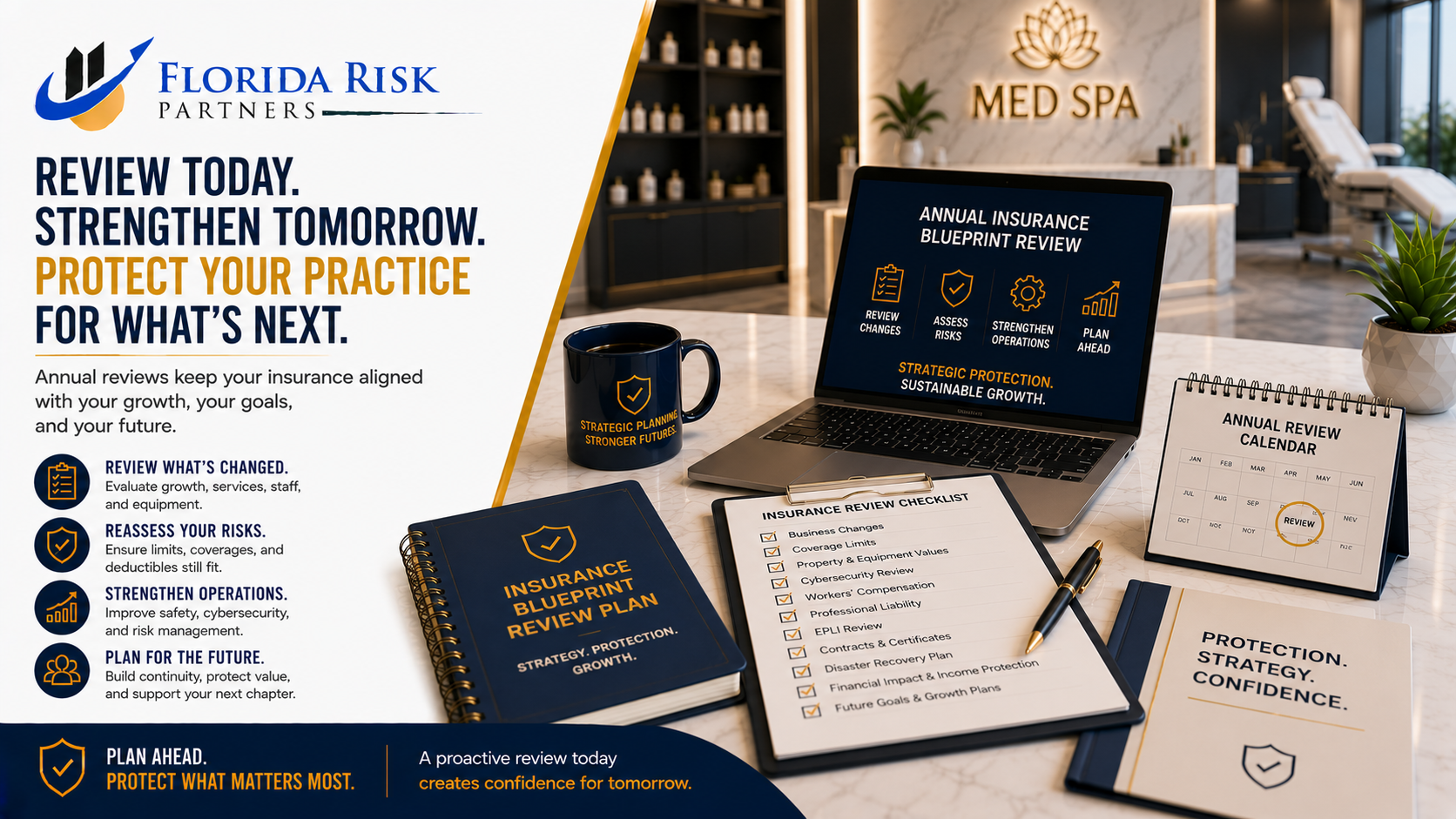
Treat the Annual Review Like a Business Health Check
The annual insurance review should function like a business health assessment.
The goal is not simply confirming that policies remain active.
Owners should evaluate the overall risk strategy.
Physicians do not judge a patient’s health using only one vital sign.
Medical spa owners should not judge insurance using only premium.
A good annual review considers the full organization.
Start With Changes in the Business
The review should begin with one question.
What changed during the last twelve months?
Medical spas rarely remain static.
Revenue may increase.
New procedures may launch.
Additional providers may join the team.
Employee counts can rise.
The practice may purchase new technology.
Tenant improvements can increase property values.
A second location might open.
Each change affects risk.
Insurance should reflect the business as it operates today.
Review Property Values Annually
Property values often change slowly.
That makes them easy to overlook.
Inflation can increase construction costs.
Equipment prices may rise.
Renovations and improvements can add substantial value.
Custom cabinetry, lighting, flooring, and treatment rooms all contribute to replacement cost.
Medical spas should review Property Insurance limits annually.
Outdated values can leave the business underinsured.
They may also create coinsurance problems depending on the policy.
Update Equipment Inventories
Medical spas regularly purchase expensive equipment.
Laser systems, radiofrequency devices, ultrasound technology, and skin analysis platforms can add significant value.
So can refrigeration systems, computers, and networking equipment.
Each purchase changes the asset profile.
Equipment Breakdown coverage should evolve accordingly.
Business Income limits should also reflect the revenue that important equipment helps generate.
Reassess Professional Liability Exposure
Clinical operations change over time.
Medical spas add providers.
They introduce new technologies and procedures.
Some expand into more advanced services.
These changes can affect Professional Liability exposure.
Owners should review policy limits and provider schedules.
Treatment descriptions deserve attention too.
Supervision arrangements and informed consent processes should also remain current.
Close communication with an insurance advisor reduces the chance of surprises later.
Review Employee-Related Risk
Growth can make workforce management more complicated.
Hiring expands.
Management responsibilities increase.
Employee relationships become more complex.
Workers’ Compensation deserves annual review.
Payroll estimates should remain accurate.
Employee classifications should reflect actual duties.
Safety efforts should also receive attention.
EPLI requires a separate review.
Employee handbooks, leadership training, documentation, and workplace policies all influence employment risk.
Cybersecurity Requires Continuous Improvement
Cyber threats change constantly.
Medical spas adopt new software.
Cloud storage expands.
Patient portals evolve.
Artificial intelligence applications may enter the workflow.
Remote access and third-party vendors add new exposures.
An annual cybersecurity review should examine technical and human controls.
Password standards matter.
Multi-factor authentication matters.
Backups, software updates, employee training, and vendor controls matter as well.
Cyber Liability limits should evolve alongside the organization’s digital exposure.
Review Operational Systems, Not Just Policies
Risk management extends beyond insurance.
The annual review should examine daily operational systems.
Preventive maintenance schedules deserve attention.
Disaster recovery plans should remain current.
Emergency communication procedures may need updates.
Inventory controls and vendor processes should be reviewed.
Lease obligations and contract requirements can change.
Quality assurance systems should evolve too.
Insurance performs better when strong operational practices support it.
Business Income Should Reflect Current Financials
Business Income limits should not rely on outdated financial statements.
Current revenue matters.
So do fixed expenses.
Payroll commitments and loan obligations also affect the calculation.
Growth projections may influence future needs.
Owners should evaluate whether the coverage could support the business during a serious interruption.
Long-Term Goals Should Influence Insurance Planning
Annual reviews should also consider future plans.
The owner may want to acquire another practice.
Expansion may be on the horizon.
Partnership changes could occur.
Succession planning may become more important.
Retirement or a future sale may eventually become part of the strategy.
Insurance should support those goals.
It should protect the long-term value of the organization as circumstances change.
Bring Professional Advisors Into the Conversation
Insurance decisions rarely exist in isolation.
CPAs provide financial insight.
Healthcare attorneys help with regulatory issues and contracts.
Financial advisors support long-term planning.
HR professionals strengthen employment practices.
IT professionals help manage cybersecurity.
Equipment manufacturers provide technical expertise.
When these advisors communicate, the owner receives a more coordinated strategy.
Ask Better Questions During the Annual Review
The annual review should move beyond one question.
“What does this policy cover?” is important.
It is not enough.
Owners should also ask:
Are we adequately protecting patients?
Are employees protected?
Can we recover from a major interruption?
Does the insurance program reflect today’s business?
Will our coverage support future growth?
These questions create better strategic conversations.
Risk Management Never Stands Still
Risk management is not a destination.
The environment keeps changing.
New technology appears.
Regulations evolve.
Cyber threats become more sophisticated.
Business models change.
Market conditions shift.
Strong organizations continue to reassess their exposures.
They adapt their insurance programs as circumstances evolve.
That mindset builds resilience.
Conclusion
Protecting a successful medical spa requires more than buying insurance policies.
Owners need to understand how patient care, employees, technology, property, and financial planning affect the business.
Long-term ownership goals matter too.
Each area contributes to the overall risk profile.
The five pillars provide a practical framework for understanding those exposures.
Coordinated insurance helps address the risks through one unified strategy.
Annual reviews allow the program to evolve with the business.
Together, these elements turn insurance into something more valuable.
They turn it into a strategic business tool.
Florida Risk Partners Insight
At Florida Risk Partners, we believe strong insurance programs begin with planning.
Education matters too.
So do long-term partnerships.
Our role extends beyond placing policies.
We help medical spa owners evaluate operational risks, coordinate coverage, identify emerging exposures, and build protection strategies that evolve with the business.
That approach matters whether you are opening your first location or expanding into several.
It also matters when you invest in new treatment technology or prepare for an eventual ownership transition.
The goal remains the same.
Protect everything you have worked so hard to build.
The strongest medical spas are not simply insured.
They are strategically prepared for what comes next.